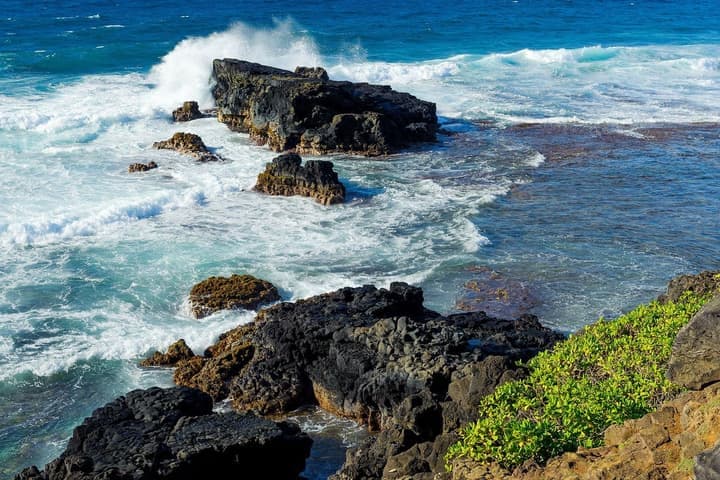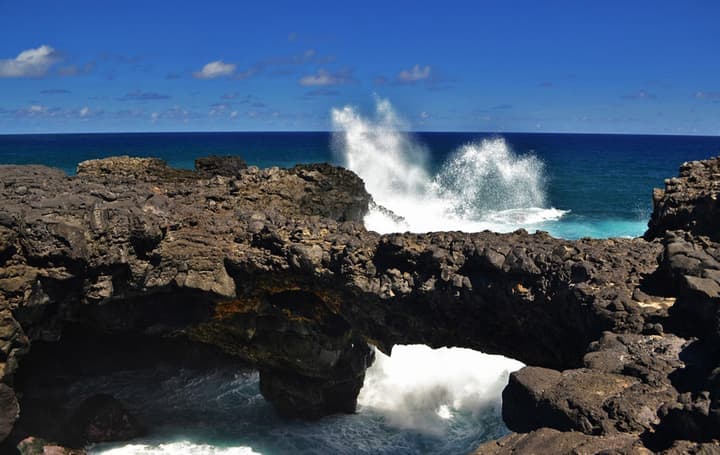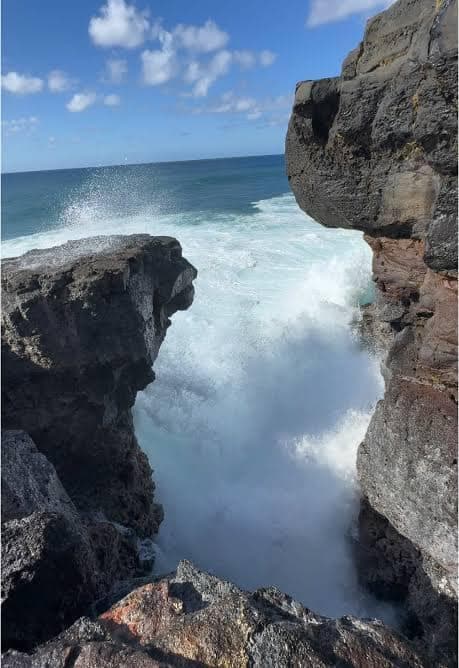
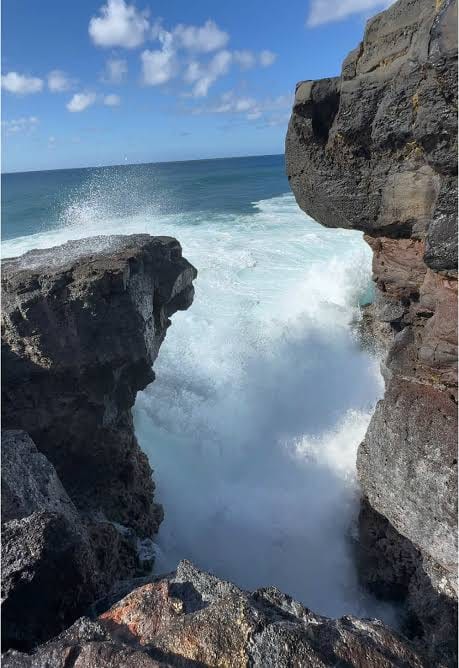

Weeping Rock, or Roche Qui Pleure, is one of the most expressive natural sights on the south coast of Mauritius. It sits near Souillac and the Gris Gris coastline, in a part of the island where the ocean feels especially open and powerful. This is not the calm lagoon scenery many travelers associate with Mauritius. Here the waves of the Indian Ocean reach the cliffs directly, crash into dark rock, rise in white spray and then run down the stone in thin streams. From the right angle, the rock seems almost alive, as if it is really crying.
Think of this place as a coastal viewpoint and a short nature walk rather than a swimming beach. People come here for the sound of the surf, the wind, the feeling of standing at the edge of the island and photographs that show a wilder side of Mauritius. Even if you have limited time around Souillac, Weeping Rock is a rewarding stop, especially when combined with the nearby views around Gris Gris.
Why it is called Weeping Rock
The name comes from the way the waves interact with the shape of the cliff. When the surf hits the rock, the water does not simply fall back into the ocean. Part of it climbs the stone, catches in grooves and then trickles down the dark surface in narrow lines. Seen from certain viewpoints, these streams look like tears running down the face of the rock.
The effect is easier to notice when the sea is active, but it should always be watched from a safe distance. On calmer moments the place is still beautiful: you can see the layers of rock, the white foam at the base of the cliffs, the deep blue ocean and the clean horizon. When the wind picks up, the scene becomes more dramatic, with spray rising higher and the sound of the waves reaching you before you are even close to the edge.
What to see
The main attraction is the section of cliff where the wave breaks against the rock and the water runs down its face. It is worth slowing down instead of taking one quick photo and leaving. Walk a little along the coast, look at the rock from different angles and wait for several sets of waves. The ocean changes every minute here, and the most memorable moment often comes after a short pause.
Beyond the rock itself, the broader south-coast panorama is part of the experience. The cliffs are irregular, with grassy edges, dark basalt shapes and open views across the Indian Ocean. In one direction you see the restless sea; in another, the green line of the coast. It is a strong contrast to the gentler beaches in the north and west of Mauritius.
Weeping Rock suits travelers who enjoy raw natural landscapes without much built-up infrastructure. There is no need for a complex itinerary at the site. The value is in the open space, the wind, the water and the sense that the ocean is setting the rhythm.
How to plan the walk
For most visitors, Weeping Rock works as anything from a short scenic stop to a relaxed coastal walk. If you only want to see the weeping effect, arrive, walk to the viewpoint, wait through a few waves and take your photos. If you have more time, combine it with Gris Gris and a look around Souillac.
Keep the route flexible. Start at the main viewpoint, check the wind and the condition of the paths, then move only along clear and comfortable ground. Do not go onto wet rock or close to the cliff edge. Sometimes the best view is not the closest one, but a slightly more distant angle where the rock, spray and wide ocean all fit into the frame.
For photography, softer light usually gives the rock more shape and makes the white foam easier to read. That said, cloudy weather can work surprisingly well here. A grey sky makes the coastline feel more graphic, and the ocean often looks heavier and more dramatic.
Safety on the cliffs
Weeping Rock is impressive because the surf is strong, so safety matters more than getting the perfect picture. Do not climb down toward the water, stand on wet rocks or approach the cliff edge, especially when the waves are high or the wind is strong. On this part of the coast the sea can look regular for several minutes and then suddenly send in a larger wave.
Swimming at Roche Qui Pleure is not the point of a visit. This is a place for watching, walking and photography, not for entering the water. If you are visiting with children, keep them close and explain before you arrive that cliff edges and wet rocks are off limits. Shoes with a steady sole are useful, as grass, soil and stone can become slippery after rain or sea spray.
How to get there
Weeping Rock is on the southern coast of Mauritius near the town of Souillac. The easiest way to visit is by car or with a driver, especially if you want to include several south-coast stops in one day. The drive takes you through a quieter, more local part of the island, which is part of the appeal: this area feels greener, less resort-focused and more rural than many beach districts.
If you are driving yourself, navigate toward Souillac and Gris Gris, then continue to the coastal viewpoints. Parking and access can vary depending on local arrangements and weather, so it is better to leave the car in an obvious safe place and walk the last part than to try to get too close to the cliff.
What to combine it with
Weeping Rock fits naturally into a day exploring the south of Mauritius. Visitors often combine it with Gris Gris, a short stop in Souillac and other natural viewpoints along the coast. This works especially well if you want to see more than calm lagoons and resort beaches.
It may not be worth crossing the whole island only for a few minutes at the rock if your schedule is very tight. But as part of a southern route, Roche Qui Pleure is a strong stop. It adds emotion, contrast and a clear sense of why this coastline feels so different from the protected lagoon areas elsewhere on the island.
Is it suitable for children?
You can visit with children if the adults are ready to manage safety carefully. The sight and sound of the waves can be exciting, but young children may lose interest if the walk becomes too long, and energetic children need clear boundaries around where they can and cannot go.
The best family format is a short stop, a few safe viewpoints and a calm walk without trying to get closer to the surf. Bring water and sun protection on hot days, as exposed areas may have little shade. After rain or in strong wind, keep the visit shorter and stay only on the safest viewing areas.
Practical tips
Arrive with enough time to watch the ocean rather than rush through the stop. The beauty of Roche Qui Pleure is in movement: one wave may look ordinary, while the next lifts higher, breaks harder and creates the weeping effect. Hold your phone or camera securely, as the wind near the coast can be strong.
Wear shoes that are comfortable on uneven ground. After rain, choose only dry and obvious paths. If you want a calmer visit, come in clear weather; if you enjoy atmosphere and dramatic photographs, an overcast day with active surf can be even more interesting.
Treat the site as a natural attraction. Do not leave rubbish, damage vegetation near the edge or climb onto unsafe places for a photo. The south coast is beautiful because it still feels wild, and the best way to enjoy it is to watch carefully and keep a respectful distance from the sea.
Final thoughts
Weeping Rock is a short but memorable stop on the south coast of Mauritius. It shows the island from a different angle: not as a calm lagoon, but as a meeting point of dark stone, wind and open ocean. Come for the powerful scenery, the sound of the waves and the feeling of natural force. Combined with Gris Gris and Souillac, Roche Qui Pleure becomes part of a compact and very characteristic route through the wilder south of Mauritius.